Introduction of a specific cultural theme (e.g. greetings, punctuality, meals).
Explanation of vocabulary, expressions and behaviors related to the theme.
Example of theme: The relationship to politeness (informal vs. formal, common expressions of politeness).
Educational tools: Slideshow, paper support, videos.
Instructions :
Listen carefully to the audio lesson. This lesson will help you understand a key new concept. If you have difficulty, feel free to go back and listen to certain sections again to reinforce your understanding.
Use the booklet to follow the key points of the lesson and note down any words or phrases that seem important to you. You can refer to it throughout your learning.
🧭 AND IN FRANCE, HOW DO WE DO IT?
Welcome to the intercultural space of your training!
Here you will discover the habits, the rules of politeness, the ways of speaking, greeting, behaving in France
👂 What you don't always learn in books, but which is essential to live and work well here.
➤ Would you do the same in your country?
➤ Why do the French react like this?
➤ And you, how can you adapt without losing who you are?
🗝️ Tip: Each situation is there to help you understand and find your place.
You are not alone!
Instructions :
This section helps you understand common practices in France. Listen carefully to the explanations and compare them with what you know about your own culture. Note the differences and think about how they might be useful in your daily life in France.
In France, we often say: "This is my brother", "This is my sister", etc.
Cultural Code: Immediate family is often mentioned, and it is common to refer to family members by their role (father, mother, brother, sister).
📌 THE ESSENTIALS
Here are the words and expressions you need to know to understand the lesson and express yourself orally.
Read them, listen to them, repeat them… and use them in your everyday life!
Instructions :
This section summarizes the key points of the lesson. Make sure you understand these essential concepts, as they are the foundation of your learning. Use this part of the booklet as a quick reference when you need to remember an important point.
"Reread this section before moving on to the exercises to reinforce your understanding."
My father
My mother
Besides
My sister
My husband
My wife
My son
My daughter
My grandfather
My grandmother
My uncle
My aunt
👨👩👧👦 Cours de Français – La Famille
I. 💬 Dialogue
👋 Situation :
Mélanie vient de rencontrer Marina. Elles font connaissance.
II. ❓ Questions
Elle a deux frères.
FAUX
FAUX
• Mélanie a des frères et une soeur
• Marina n'a pas de frères ni soeurs
III. 👨👩👧 La famille de Julie
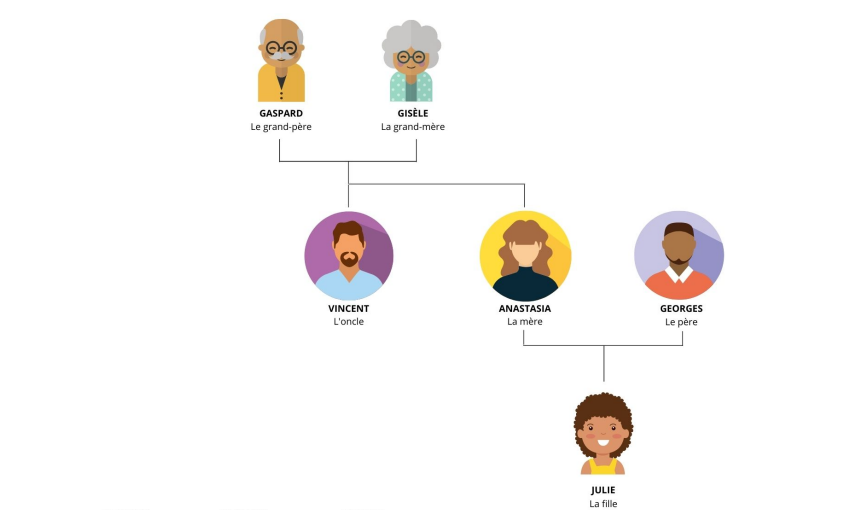
Arbre généalogique de la famille de Julie
- Julie est la fille de Anastasia et Georges
- Vincent est l'oncle de Julie
- Julie est la nièce de Vincent
- Gaspard et Gisèle sont les grands-parents de Julie
- Julie est la petite-fille de Gaspard
- Georges est le gendre de Gaspard et Gisèle
- Gaspard et Gisèle sont les beaux-parents de Georges
- Julie n'a pas de frères ni soeurs
- Léo a une tante. C'est la soeur de sa mère.
- Le père de Maxime s'est remarié. Maxime a maintenant un demi-frère.
- Ma cousine est la fille de mon oncle.
- Les grands-parents maternels sont les parents de la mère.
IV. 💍 Les différents statuts familiaux
• Marc a 20 ans. Il est célibataire.
• Morgane a perdu son mari. Elle est veuve.
• Pierre et Sophie sont divorcés depuis 2 ans.
• Marie est mariée depuis 10 ans.
• L'enfant adopté a trouvé une nouvelle famille.
🗣️ Vocabulaire de la famille
Père/Mère
Frère/Soeur
Grands-parents
Oncle/Tante
Cousin/Cousine
Neveu/Nièce
Célibataire
Marié(e)
Divorcé(e)
 English
  French
No Comments