
Introduction of a specific cultural theme (e.g. greetings, punctuality, meals).
Explanation of vocabulary, expressions and behaviors related to the theme.
Example of theme: The relationship to politeness (informal vs. formal, common expressions of politeness).
Educational tools: Slideshow, paper support, videos.
Instructions :
Listen carefully to the audio lesson. This lesson will help you understand a key new concept. If you have difficulty, feel free to go back and listen to certain sections again to reinforce your understanding.
Use the booklet to follow the key points of the lesson and note down any words or phrases that seem important to you. You can refer to it throughout your learning.
🧭 AND IN FRANCE, HOW DO WE DO IT?
Welcome to the intercultural space of your training!
Here you will discover the habits, the rules of politeness, the ways of speaking, greeting, behaving in France
👂 What you don't always learn in books, but which is essential to live and work well here.
➤ Would you do the same in your country?
➤ Why do the French react like this?
➤ And you, how can you adapt without losing who you are?
🗝️ Tip: Each situation is there to help you understand and find your place.
You are not alone!
Instructions :
This section helps you understand common practices in France. Listen carefully to the explanations and compare them with what you know about your own culture. Note the differences and think about how they might be useful in your daily life in France.
In France, we often say: "I am [physical/emotional adjective]" to describe ourselves. Example: "I am tall, I am happy, I am tired."
Cultural Code: When describing someone, the emphasis is on physical traits (height, hair color, etc.) and sometimes personality traits. It is rare to mention money or social status unless it is relevant.
📌 THE ESSENTIALS
Here are the words and expressions you need to know to understand the lesson and express yourself orally.
Read them, listen to them, repeat them… and use them in your everyday life!
Instructions :
This section summarizes the key points of the lesson. Make sure you understand these essential concepts, as they are the foundation of your learning. Use this part of the booklet as a quick reference when you need to remember an important point.
"Reread this section before moving on to the exercises to reinforce your understanding."
I have [color/length] hair.
I have [color] eyes.
I am [physical adjective: tall, short, thin, etc.].
He/She has [hair/eyes] [color/shape].
He/She is [physical adjective].
He/She is wearing [clothing].
👤 Cours de Français – La Description Physique et le Caractère
I. 👁️ La description physique
📏 La taille
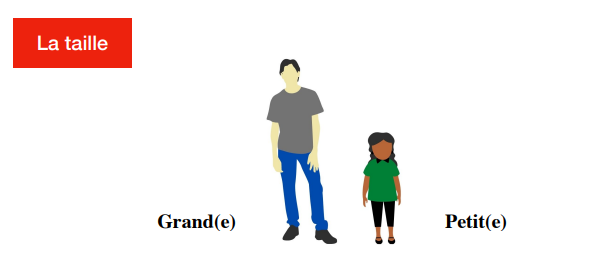
Différences de taille
• La voisine Marta est très grande.
• Sammy est petit.
• Mon frère est de taille moyenne.
• Elle est plus grande que son cousin.
👵 L'âge
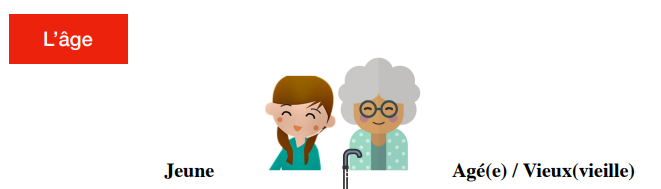
Différents âges
• Gisèle, la mamie de Patrick, est très âgée.
• Luc a 6 ans. Il est tout jeune.
• Mon père est d'âge mûr.
• Elle a la trentaine.
💪 La corpulence
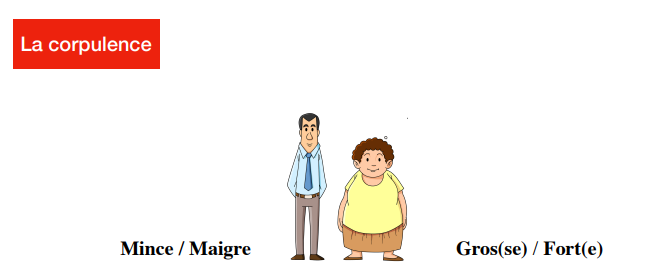
Corpulences variées
• Sophie a suivi un régime strict. Elle est devenue très mince.
• Sébastien est un homme fort.
• Il a une corpulence moyenne.
• Elle est menue et élancée.
👀 La couleur des yeux
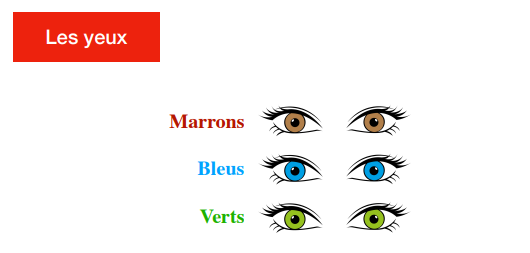
Couleurs d'yeux
• Carole a de beaux yeux marrons.
• Sylvie a les yeux bleus, mais son fils a les yeux verts.
• Il a les yeux noisette.
• Ses yeux sont gris-bleu.
💇 La couleur des cheveux
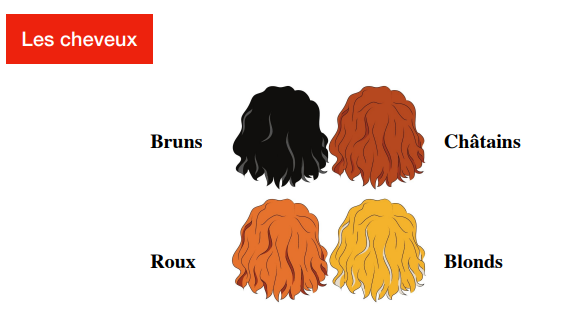
Couleurs de cheveux
• Mathéo est allé chez le coiffeur. Il s'est teint les cheveux en blonds.
• Justine a les cheveux roux.
• Magali a de beaux cheveux bruns.
• Il a les cheveux châtain clair.
• Ses cheveux sont poivre et sel.
👗 La longueur des cheveux et vêtements
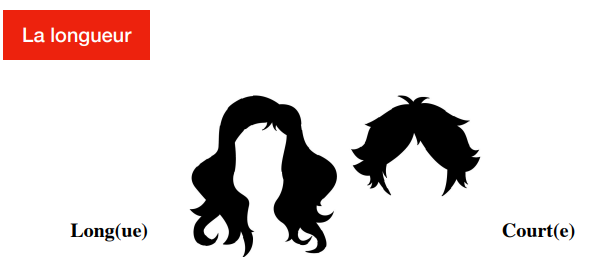
Longueurs différentes
• Marc a coupé ses cheveux. Il a les cheveux courts.
• Magali a de beaux cheveux longs.
• Lara porte une jolie robe longue.
• Il a les cheveux mi-longs.
• Elle porte une jupe courte.
II. 😊 Le caractère / la personnalité
Qui est agréable.
Qui se conduit mal.
Qui n'aime pas l'effort.
Qui donne sans compter.
Qui a la faculté de connaître et de comprendre.
Qui est comique.
Qui ne pense qu'à lui.
Qui a de l'énergie.
Qui manque d'aisance, d'assurance avec autrui.
Qui parle beaucoup.
• Julien est un collègue très gentil.
• Marine est une amie drôle.
• Mon frère est très généreux.
• Elle est timide mais très intelligente.
III. 💬 Dialogue
☕ Situation :
Suzie doit rencontrer sa nouvelle collègue Marine à la cafétéria. Ne s'étant jamais vu auparavant, les deux femmes se décrivent afin qu'elles puissent se reconnaître facilement.
🗣️ Vocabulaire utile pour décrire
Grand/Petit
Mince/Fort
Jeune/Âgé
Cheveux longs/courts
Yeux bleus/verts/marrons
Vêtements colorés
Gentil/Méchant
Drôle/Sérieux
Timide/Bavard
 English
  French
No Comments